Malta had been hot. We felt it bumping over the roads on its iconic buses with stinky teenagers, exploring the neglected ancient temples, and wandering around the maze-like streets of its cities, where the sun’s intensity was magnified by the white stone buildings and pavement. We found occasional relief under cafe umbrellas, or in the pool of our hotel (at which the advertised “private beach” turned out to be a small patch of artificially located sand next to a small pier with a ladder, where the water was infested with jellyfish for most of our stay).
Little did we know, it was about to get hotter.
We were due to fly out of Valletta in a couple days, and after five days of ruins, sunburn, mediocre meals, and the absence of a good cup of coffee, we were pretty ready to go home. Our friend Lori was heading back to London, and Beth and I were sort of at a loss for what to do with our last couple of days on our own. We decided on Mdina and the tri-cities for the first day, and after several email exchanges and missed phone calls (this was 2009, and pre-widespread use of smartphones) we managed to track down a fledgling agrotourism company and book an “experience of spending time with the sheep farmer and cheesemaking” for our final day.
So, after packing our stuff on Thursday morning, we hopped on the Gozo ferry one more time, transferred to a bus, and were met at the main bus terminal by Victor Galea, local entrepreneur and secretary of the Gozitan Green Party. He drove us to a village, where we were surprised to learn that a typical “farm” is often a small house attached to a small barn with a small concrete barnyard. These farms were all directly to adjacent to one another in the middle of town. Looking at the block from the front, I never would have guessed they were anything but houses and garages.
We weren’t the only participants, as the whole reason we were able to schedule the visit at the last minute was due to a group of mostly Belgian sociology students who were working on a photo documentary project. The farmer’s name was Zeppi, like many men in Malta and Gozo. He was a fairly fluent English speaker with a strong Maltese accent, and he introduced Belgians and us to his menagerie: goats, sheep, (or “ships” as Zeppi pronounced them), chickens, and cages of tiny white rabbits.
I was kind of shocked that the rabbits were white. Rabbit is one of the national dishes of Malta, but rabbits no longer live wild, having been long ago hunted to extinction. For some reason, I had pictured farmed rabbit being little brown and grey bunnies like the ones that are always hopping around Chicago lawns. But nope, Zeppi’s rabbits were fuzzy little snowballs. (Rabbits for Pets or Meat from Roger and Me kept coming to mind.)
It was a little bit of a grown-up petting zoo, as we tried our hands at milking a goat, feeding some lambs, and gathering some eggs from the henhouse. And then… Zeppi handed us rakes, shovels, and brooms. It quickly became clear that we were supposed to clean the barnyard. So, we spent the next hour shoveling sheep shit and hay, sneezing, etching, and sweating under the never-hotter Mediterranean sun, and the gaze of three cows, peering at us from some cactus at the adjoining farm.


Beth and I stuck it out to the end, but one by one, the students wilted: the first one running inside to puke from either heat exhaustion or hangover, and the others occupied with taking photos or playing with an incredibly scrawny barnyard kitten Zeppi had recently adopted. They girls were calling it “skarminkel,” which they explained to us as meaning something like “skinny ugly thing that we love.”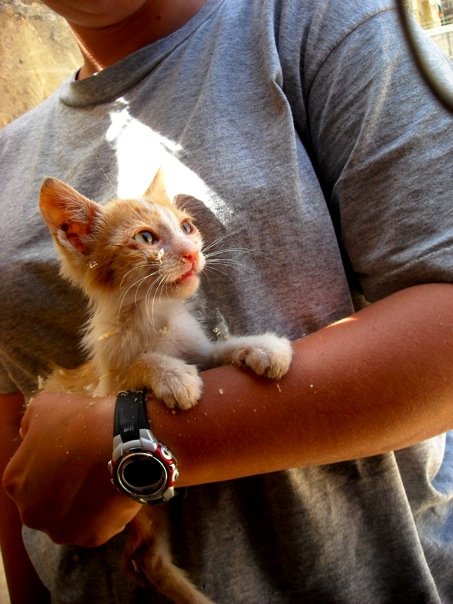
It was a pretty small barnyard, so eventually we ran out of shit to shovel and were invited in to clean up and accompany Victor on a trip to the village bakery. This was fantastic. We learned that in addition to baking bread for homes and restaurants in a village, bakeries can serve as central ovens, where people can take food to be baked. We picked up bread, and a hearty lunch of baked chicken with vegetables, took it back to the farmhouse, and shared it at a long table in the green tile-floored kitchen with Zeppi and his wife.


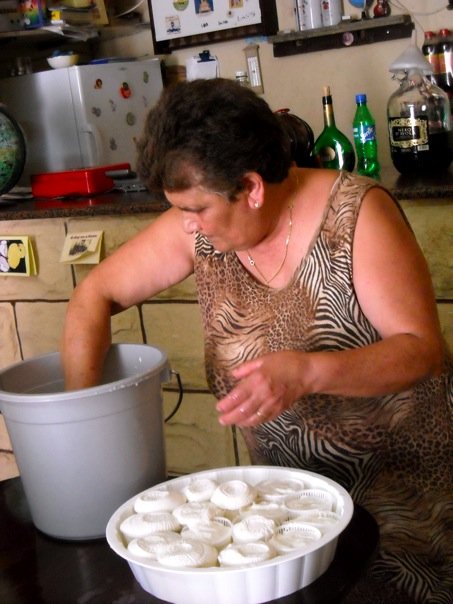
After lunch, Zeppi talked about traditional cheesemaking, and his wife demonstrated making the ubiquitous ġbejniet cheese, letting us help fill the little plastic baskets that they now use instead of straw baskets.
We were getting pretty sleepy, but Zeppi had more to show us: his prize ram, tied up in a shed next door. The ram, though healthy, looked like he’d seen better days. We soon learned why, as Zeppi Zeppi produced a vintage pair of shears, and had us each contribute to the ram’s amateur, uneven haircut. “My ram,” boasted Zeppi, “is so strong. If you have 100 ships, he will put them all pregnant!”
He then had us each put our feet up one by one, so he could clean all the manure and dirt off our shoes with a brush, said goodbye, and sent us on our way.
Notes:
My trip to Malta was in June, 2009. For more detailed descriptions typical food served in Malta, check out: http://www.maltauncovered.com/culture/maltese-food/.
 Eat My Way There